Juheb Jhony:
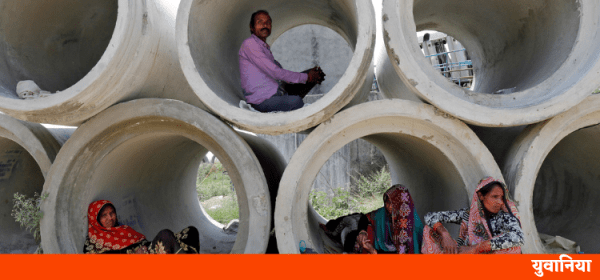
Ahmedabad has just been confirmed to host the 2030 Commonwealth Games. The city is already being remade: new roads to the stadium, new corridors, the familiar choreography of “world-class” infrastructure and, as always, an invisible workforce of migrant construction labourers who will build it all. The timing is no coincidence: within the same fortnight that the Games were formally awarded, the Union government notified the four new labour codes, a reform that rewrites the terms on which India’s working classes will live and work. Together, these two developments sketch a stark picture of who mega-events are really for.
We don’t have to guess what this means on the ground. Delhi’s 2010 Commonwealth Games are a documentary record of what happens when a city is put on a deadline, and the cheapest, least protected labour is made to carry the weight. One of the most comprehensive civil-society studies from that period, commissioned by the Commonwealth Games, Citizens for Workers, Women & Children coalition, surveyed roughly 700 workers across ten major sites. More than half reported wages below the legal minimum; most had no identity cards, no wage slips, and no access to PF/ESI. Safety gear was absent or perfunctory; women were paid markedly less than men; children were present at hazardous worksites because there were no crèches.
The picture was so egregious that even a Delhi High Court–appointed committee said the quiet part aloud: workers at Games sites were not being paid minimum wages, were made to work overtime without compensation, and were housed in “crowded hovels” with filthy or no toilets. The panel’s recommendations were basic: register workers, ensure hygienic living spaces, pay wages properly, yet compliance remained elusive through the final rush. People’s Union for Democratic Rights (PUDR) kept returning to sites and found the same violations “continued unabated”: below-minimum wages, withheld pay, no muster rolls, no proof of employment.
Beyond the fence lines of the stadiums lay the other cost of “beautification.” Housing and Land Rights Network (HLRN) documented the displacement and eviction of over two lakh people linked to Games-related projects, while press briefings around that research flagged scores of worker deaths at or around construction sites, numbers obscured by poor reporting and compensation gaps, but significant enough to puncture any narrative of a victimless makeover. The workers’ housing was barracks of tin and tarp; mosquito-ridden, without potable water or drainage.
If the 2010 Games showed us the method, the 2025 labour-codes notification supplies the legal architecture. The Industrial Relations Code raises the threshold for prior government permission to retrench or close establishments with up to 300 workers, perfectly sized for the sub-contracted units that populate an infrastructure project. Inspectors are recast as “facilitators,” with risk-based, randomized inspections that reduce on-site scrutiny. Many violations are now compoundable, fines that a large contractor can treat as a manageable cost of business. Fixed-term employment is formalised, allowing hyper-short contracts that drop workers the instant a deadline is met. On paper, the new framework promises universalisation of social security, even a national wage floor; in practice, it relies on digital registration and diffuse contributions that chronically miss the very migrants and casual labourers who build our cities.
The state says these codes will simplify, modernise and align India with global standards. India’s biggest trade unions have called the rollout a “deceptive fraud,” warning that flexibility for employers has come paired with weaker rights and weaker enforcement for workers, and they have already taken that fight to the streets. When we place those claims next to what we observed in 2010, the risk is obvious: what was once illegal and had to be hustled past inspectors can now be normalised, routineised and settled as a compliance hiccup.
Already, early reports from Ahmedabad’s road-widening and access projects carry the familiar language of clearance and demolition around working-class settlements near the stadium. This is how the “model city” is made: by displacing the poor to move the rich more efficiently, while the hands that pour the concrete remain undocumented. The 2030 Games do not have to repeat Delhi’s playbook, but the incentives and the law now point in the same direction.
PUDR’s earlier observation that labour violations at Commonwealth Games sites persisted without pause acquires a new and unsettling meaning today. Under the current legal framework, where inspections are sporadic, subcontracting conveniently obscures responsibility, penalties amount to little more than administrative fees, and workers can be cycled out every few months under fixed-term contracts, the space for genuine accountability all but disappears. The stadium will still be completed on schedule, the dignitaries will still cut the ribbon, and the city will bask in its moment of pride. Yet beneath that spectacle lie stories that rarely find a place: the overtime never compensated, the wages quietly withheld, the woman forced to bring her child to a dangerous construction site because she has no alternative. These are the truths that remain outside the frame of celebration.
This is why the labour codes and the Commonwealth Games belong in the same story. Mega-events compress time and inflate ambition; they thrive on a workforce that can be made infinitely flexible and instantly disposable. Delhi taught us that under deadline pressure, law bends toward capital unless it is enforced with teeth. The 2025 codes have blunted those teeth. In Ahmedabad, where an international spotlight will soon meet an accelerated construction calendar, that combination all but guarantees that the costs of glory will be socialised on the bodies and wages of workers who cannot afford them.
A different legacy is possible. It begins with naming the past accurately, funding and enforcing real registration and social security for every worker on every subcontract, restoring meaningful inspections, mandating crèches and decent housing as non-negotiable line items, and prosecuting wage theft and safety violations as crimes rather than fees. The Games should test our infrastructure; they should not test how much exploitation a democracy is willing to hide. The law we have just notified makes the wrong answer too easy.
The question now is whether the city and the country will accept it.
Sources:
- Commonwealth Games–Citizens for Workers, Women & Children (CWC) Survey, 2009.
- Delhi High Court Monitoring Committee Report, 2010.
- Housing and Land Rights Network (HLRN), “Whose Wealth? Whose Commons?”, 2010.
- People’s Union for Democratic Rights (PUDR) Reports, 2009–2011.
- Government of India Labour Codes Notifications, 2025.

Leave a Reply