Arshia Kashyap :
In most countries, a recession is underway. Unemployment is rampant, and unskilled labourers are already at a loss for jobs. Meanwhile, issues of war, displacement, regional inequality, and persecution based on socio-political factors continue to persist. All these factors eventually contribute to the rising population of people becoming migrants.
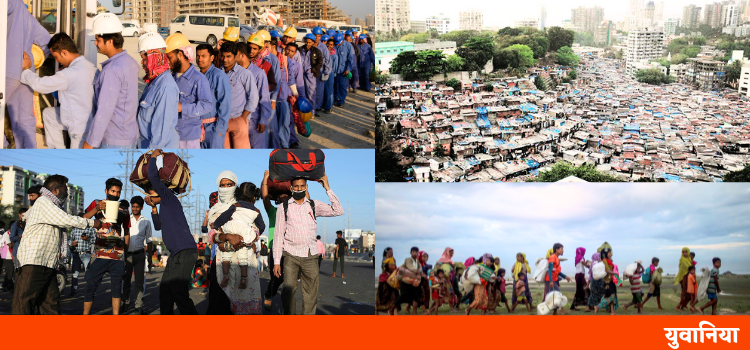
Migration, or the act of leaving your region to go to another, especially for employment or safety with the intention of settling, happens at two levels. At the internal level, where migrants stay within the periphery of the country, and at the international level, where people leave their country for a better life. Most migration is of the rural-urban kind, where people leave rural areas for urban ones due to better opportunities.
Migration is generally done to improve a person’s quality of life. For those who are unemployed, migrating might mean the prospect of a job with a stable income. Others might do so for healthcare, education, or for environmental reasons. People often leave a region to improve the quality of education and medical facilities they have access to, but displacement due to climate change is becoming a leading factor. With floods, earthquakes, and other disasters increasing, migration from affected regions such as Odisha and Assam is rising, with projected climate migrants to reach 45 million in 2050.
The issues of wars and persecution are also big ones. The majority of asylum seekers to the EU include those from war-torn Syria, Afghanistan, and Venezuela. Others might be affected by government policies or oppression, forcing them to migrate. There is also a direct relationship between displacement and migration. When people are displaced due to a variety of reasons, they often have no other choice but to migrate. In such a scenario, the migration is forceful, as it is born out of circumstances that individuals have very little control over.
However, it has been found that migrant workers from marginalised communities are highly likely to face discrimination even in their new location of work. In India, caste and tribal status influence migration and the experience of migrants. People from scheduled castes and scheduled tribes formed 16% and 9% of migrants respectively, yet over half of ST workers work as helpers, and 30% work as masons. Meanwhile, 66% of upper-caste female migrants work in white collar jobs, while 19% of SC women and 18% of ST women do so.
Meanwhile, even after migration, migrants are likely to have bad experiences. They face discrimination at their workplaces, but are often unable to access government welfare programmes such as reservations once they leave their state of residence, which hampers their livelihood, especially when they are otherwise unable to progress highly in their new residence. A quarter of dalit immigrants in the United States shared that they had experienced discrimination of some sort. Women, especially, are at a greater risk of violence, and often become isolated as domestic workers.
In states like Kerala, not migrating has an adverse impact. A lot of wealth in Kerala was acquired through migration to the Gulf. However, only 0.9% of the migrants were from SC and ST communities in 2018, showing that people from disadvantaged communities often lack the resources to be able to migrate and improve their livelihood in the first place.
It then becomes important to note that those from privileged backgrounds are generally employed in highly skilled jobs and even have additional money that they are able to send back home, while those from the fringes of society are forced to take whatever job they get, and are often unable to sustain themselves. They are also likely to be short-term migrants who operate in circular migration- migrating seasonally when job markets improve somewhere else and returning home. This is not as common in upper castes, showing that they are more likely to have stable, comfortable lives post-migration. This is true even when international migration occurs.
All migrants have human rights such as the right to a livelihood, which includes a house, clean water and sanitation, and regular food. They also have the right to have a livable wage and a safe environment, and if their current residence violates these rights in any way, they can migrate to access a better life. Even in situations where such requirements are met, human beings have the right to access cities or other locations simply because we have freedom, which includes the freedom to be mobile and live where we want to.
Thus, migrants have a right to live in cities if they so desire. However, they usually have to face some level of hostility from city dwellers. This may be discrimination at their place of work or in their personal lives, while there is also an economic fear that migrants will take the jobs of the natives, leading to an employment crisis. The presence of migrants is thus constantly questioned, even when they live less than ideal lives and often form the backbone of city functioning, due to casteist notions leading to migrants from SC and ST communities engaging in house-help services, rag picking, and construction work.
Due to such hostility, discrimination, and hierarchies prevailing in the lives of migrants, they are unable to access the rights that they have. Most nations, including India, do not have a dedicated framework for protecting the rights of migrants. While constitutional provisions exist for equality, non-discrimination, and the freedom to move, their impact is limited, as most migrants lack the resources to seek constitutional remedy when their rights are violated.
At the legal level, a framework needs to be created to ensure that the rights of migrants are not violated. There needs to be a greater emphasis on accessibility of this framework, including ground-level execution, especially within government offices and spaces, since migrants are often employed there in low-level positions such as security guards and cleaning crews. Regulations in other, non-government-controlled workspaces also need to be introduced.
There needs to be greater freedom in the creation of unions, especially in the manufacturing sector, due to the high incidence of migrant workers in these spaces. Healthcare and other basic needs, such as minimum wage and sanitation, need to be fulfilled, and this can only be done when an emphasis is placed on overall human development in impoverished areas.
In slum areas, camps, and areas of high poverty, efforts need to be made to improve the quality of such areas as a whole, as they are often made up of migrants and migrant families, stuck in generational poverty. There also needs to be increased education for migrants and non- migrants alike. Migrants must be taught how to access regulations that safeguard their rights and quality of life, while all people must be taught about the history and current context under which migration occurs. People need to be taught about respecting the rights of migrants and how they must do so. Without all these mechanisms in place, the condition and position of migrants will continue to deteriorate.
Photo Credits : द इंडियन एक्सप्रेस ; अलामी ; कारवां ; नेशनल जियोग्राफिक

Leave a Reply