Arshia Kashyap:
The Zafar Mahal was not always a rundown structure where children came to play and adults came to socialise. The walls were not always broken and crumbling, and black soot, algae and mold were unknown to the building. This monument was built as a response to British colonialism- with Akbar Shah II building it to oppose the colonialists setting up constructions in the country, especially after the Mughal rulers lost power and influence post the annexation of Delhi in 1803. This summer palace was the hub of political activity- with the Mughal court moving there for a few months of the year. Mirza Ghalib would engage the emperor in poetry sessions, and with the Dargah of Qutbuddin Bakhtiar Kaki being located adjacent to the mahal, his Urs, or death anniversaries were also held near the Zafar Mahal. The festival of Phoolwalon ki Sair, literally the festival of flower sellers, was also held here, and continues to happen annually.
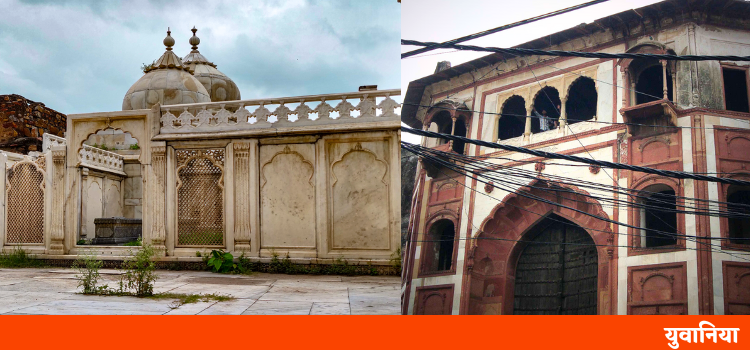
The entrance gate, also known as the Hathi Gate due to its large size that allowed the entry to elephants, was built by Bahadur Shah Zafar II, who changed the name from Khas Mahal and named it after himself. The Hathi Gate is made of red sandstone and leads to the south and the east side of the palace. Curves are crucial to the structure and are used to embellish the gate. The huge wooden door is still intact, and is built in the late-Mughal style architecture- represented by chajjas and the domes with alcoves inside. The jharokhas- projected windows- are a standout feature. This is the best preserved part of the monument, and yet, the stone is chipped in various places and graffiti lines the walls. A black crust lines the top section of the gate and people carelessly smoke right outside the structure. At almost all points in the day, people can be found sitting on the broad and extended bit of the gate. One can hardly imagine this to be the entrance to the summer palace of a Mughal king.
The tombstone of Alauddin Masud Shah, the Delhi Sultan from 1242-46 can be found on the premises. Next to it is the Moti Masjid, which was built by Bahadur Shah Zafar 1 between 1707 and 1712. Verandahs and compartments surround the court, and domes are a common element of this palace. The use of floral embellishments and traditional Mughal architecture (representative in how similar this area looks to the Chhata Chowk of the Red Fort) is indicative that perhaps there was attempt made to recall the glorious reign of the Mughal emperors- especially given the strengthening hold of the British over Delhi. Yet, lack of funds in the treasury forced the emperors to employ subpar masonry and skip opulent stones and materials that are found in other buildings of the Mughal era.
The Naubat Khana, or the drum house, was an important part of the palace. Built by Bahadur Shah Zafar II, musicians made announcements about the arrival of the emperors in the Naubat Khana and performances for the appeasement of the emperor were also held here. The pillars of this room are carved beautifully, but unfortunately, it has become more of a cricket playground for local children rather than a piece of history that needs to be appreciated and preserved. From all sides, signs of encroachment are visible. Multi-storey houses surround the monument, as new constructions take place beside the crumbling walls. Vandals have vandalised the graves of Mirza Jahangir and Akbar Shah II, and the jaalis near the tomb were badly broken. The Archaeological Survey of India has done little to preserve the monument, despite it being ASI protected and having been declared a monument of national importance in 1920.
This monument is also the site where Bahadur Shah Zafar II wanted to be buried, and even had a designated area near the existing graves on the site. However, when the British captured him, he was exiled to Rangoon, where he spent the final years of his life. He longingly wrote about this-
kitnā hai bad-nasīb ‘zafar’ dafn ke liye
do gaz zamīn bhī na milī kū-e-yār meñ
How unlucky is Zafar! For burial,
Even two yards of land were not to be had in the land of my beloved.
It is then saddening to see the state of the Zafar Mahal. Once the home to royal procedures and functions, the upper floor now barely exists as broken stairs and roofs can be found all over the palace. According to a report by The Hindu, the ASI Superintending Archaeologist, Praveen Singh, said that repairs have not been done for at least 10 years. Pigeon droppings eat away at the walls, and the structure is at danger of falling apart. Its cultural relevance is undeniable- from its origin during the Mughal period and to the freedom movement, for this was the site where Subhas Chandra Bose vowed to free India, and Mahatma Gandhi too declared a fast unto death for communal harmony at the Zafar Mahal.
The issue then is not the monument being ‘alien to our culture’ or ‘irrelevant’- it is human negligence. Unawareness and apathy has led to us distancing ourselves from history as a whole, and not taking accountability or action for the deterioration of such monuments. Even if restoration is the prerogative of the government and the ASI, the least we can do is to not further destroy such sites. This includes not littering or adding graffiti, but also to stop others from doing the same. As a society, we need to become more aware about our own history and lesser known monuments such as the Zafar Mahal. Especially in times of partisanship where governments are using historical sites to fuel their agendas (especially ones on communal lines) it becomes even more important to be aware of these monuments, especially those built by minority communities.
Even then, it is important to understand the human intentions with which such places are built. Not only are they a celebration of art, culture and architecture, they are also representative of human creativity. It is clear that the disregard for such monuments exists because we do not value their existence- that is to say that we do not value the stories, art and culture that they stand for. The only way to truly preserve buildings of historical and cultural relevance is to bring about a societal change in how we view history, people, communities, artistry and heritage. When schools and educational institutions take the forefront in celebrating these activities and more media coverage about the same exists, we can expect the disinterest to lose hold and for people to become more aware and knowledgeable.
Photo Credit: http://Photograph by Anupam G / Wikimedia Commons (available under CC BY-SA 3.0)
http://Photograph by Pawan Kamrani / Wikimedia Commons (available under CC BY-SA 4.0)


Leave a Reply