रोहित जैन:
These photos were taken by Rohit Jain and were published in Asia Times in the year 2018. He captured these photographs during his visit to Chittorgarh district, Rajasthan.

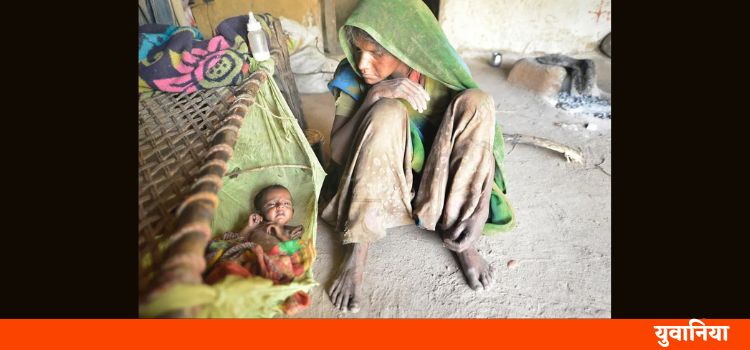
Gopi Pyara Bhil, 40, with her five month old daughter Bamri at her home, in village Bheru khera.
A Bhil tribe woman, Gopi Pyara, 40, is mother of eight living children, while one died. She is unable to lactate since giving birth to her youngest daughter who was already born underweight, worsening her chances of survival. Two of her teen aged son work as bonded labour at a farm field for which they get wheat. Around the year whole family feed on wheat roti (round flatbread) and curry made of wild grass which they store dried.
According to Nobel Laureate economist Amartya Sen, “poverty is a real deprivation of the basic capabilities that enable people to access and make use of this income and other amenities in the society”.
Former Prime Minister of India, Indira Gandhi’s 1971 election campaign slogan “abolish poverty, save nation’ to current Prime Minister Narendra Modi’s inauguration of Bullet Train, gives us an impression that India has certainly abolished poverty and that people of this democratic nation have gained the capability to live a kind of lives they have reason to value. We are wrong! Poverty exists! at the extreme!
Many Indians living in cities, dream of a blue-collar job, big house and car, wearing the garb of growth and economic development might not be able to even imagine what poverty looks like. Of course, it is hard to imagine until one lives the life of it. It cripples a human being in the modern economy which talks about ‘shining’ growth. In a country where the GDP rate is 7.2 %, people mainly who belong to a scheduled tribe and scheduled caste still living in extreme poverty, aren’t against basic human rights. I visited seven villages in the Chittorgarh district in Rajasthan in India. Rajasthan state where the Bhil tribe make up 39% of the tribal population. Tribal villagers in the district had no economic stability, healthcare or even education, with some often being forced to take up bonded wage labour, with monthly incomes as low as US$7, and sometimes even nothing.

Ramlal Bhil, 50, is a Tuberculosis patient, at his home, in village Ganpat Khera.
Former wage labour, Ramlal, is patient of Tuberculosis for last three years. He survives alone as his wife left him years ago. For whole day he rests under a neem tree on his cot while his relatives offer him leftover food and fill a pot of water for him. Every morning he crawls to bushes for defecation.
I have come to know that Ramlal passed away recently. The last time I met him was on 30th April 2018.
“With a lack of proper diet but overworked, there are many people in these villages who are affected or died from Tuberculosis,” said 68-year-old Khemraj Choudhary, a social activist who has been working delicately for the welfare of communities in this area.

Mangna Jatia, 60, with his wife Pudi, returns to his village Dhamni Khera.
Mangna Jatia, belongs to a schedule caste, return to his village from a temple along with his wife Hudi who is handicapped. He will drive the wheelchair of his wife for four kilo meter under a scorching sun. To save money mostly they avoid using paid transport. Hudi has covered her face to protect herself from heatwaves.
Their three children passed away due to disease when they were young. Mangna and Hudi live by themselves on government pension of only rs 500/each (USD7.37). Next day I heard from a villager that ‘this morning Mangna and his wife walked for 10 KM to the bank in nearby Tehsil of Bhadesar to withdraw Rs. 500 (USD7.37). After withdrawing money they got in to Bus to visit a relative’.

Beri Bhil, 33, assembles the bales of wheat to be threshed, at her farm field, in the village of Hati Pura.
33-year-old Beri Bhil and her husband cultivate about 1.2 acres of farmland. They earn approximately rs 45000 (US$663) per year. The couple gives 70% to the landowner and still has to pay for labour and machinery. Eventually, they are left with rs 9000 (US$127) to sustain their family of six for the entire year.
Their very low income forces the couple to borrow money from their landlord which keeps them into a cycle of debt.
This year, Beri Bhil hopes to earn a profit of Rs. 6000 (US$88) from the half acre of land she owns with her husband. She has borrowed water from a neighbour to irrigate her fields which will cost her 30% of her harvest.

Mangi Bhil, 14, manages her relative’s cattle, in the village of Bheru Khera.
Mangi Bhil, 14, went to school for two days but never returned after an assault by her teacher. Now she grazes her young goat everyday. She won’t have any income this year as her goat is too young to sell.

Kalu Lal Bhil, 23 and his wife Sharda, 20, at their home, in village Bhilon Ka Khera.
Kalu Lal, 23, has been working as wage labour since he was 15 year old. He never went to school. His mother said “my parents never sent me school. I didn’t know what school use to be. So we didn’t send Kalu to school”.
His wife Sharda studied till class 5th. She was studying in class 3rd when she got married. She continued her school next two years from in-laws’ house. Don’t you want to study further? She replied shyly “I want to but he doesn’t want me to continue further”.
Kanchan Bhil, 25, cooks at her home at 8:45 Morning not evening, in village Bhilon Ka Kheda, Chittorgarh. She doesn’t complain about the lack of light in her kitchen. She thinks it’s enough light. What more daylight she can ask for?
Every day she cooks only roti (round flatbread) and a sabji (vegetable curry) for which her family of 2 adults and 3 children consume 500 ML of cooking oil and around 40 KG of flour in a month. Generally, her children don’t ask for special dishes but sometimes when children ask, adorably she has to say ‘not today, when we will have money we will cook it’.

Shayari Bhil, 40, at her home, in village Bheru Kheda.
The lack of education and healthcare has also created a dependence on superstitions in the villages. Shayari Bhil, 40, is one of such examples. She saw a bhopa, or sorcerer, in a bid to solve the stomach aches she had suffered for a long time. The sorcerer touched the spot on her stomach with a red hot iron to “remedy” the pain.
“It is not easy for the poverty-stricken to get treatment from a qualified doctor or in a hospital. There are government hospitals … but making several visits costs money, so overall, seeing doctors becomes a task. Superstition and quacks are easier to access for people here,” said Choudhary.
Shayari lives with her mother who is 60 years old. She owns one bigha of land (1618 sq. mt.) which she has given to someone else to cultivate. This year she got only two quintals of wheat which she had to pay back as her debt. For now, she survives without single money except local activist Khemraj Choudhary has arranged Rs 1000 of monthly ration for her through his friend.

Dhanni and her husband work in a small-level brick factory while their son Om Prakash gets bored and plays around and their daughter Sapna (not in the photo) grazes a herd of goats in the field nearby, at village Ganga Khera.
Together they work in this brick factory owned by their friend Jamnalal. For preparing a brick they get rs 0.50 per brick (less than one US cent) which includes preparing of clay by manually cleaning the impurities like vegetation, pebbles etc, kneading of clay, then keep it for 3–4 days. Then mould the bricks and organise them to be dried up. Thus in a month both of them prepare on average 7000–8000 bricks.

Pushpa Bhil, 23, along with her Mother Bardi Bai milking goat’s milk in a teacup during morning. Their goat can hardly produce milk more than a teacup, at her home, in village Bheru Kheda.
Pushpa lives with her mother Bardi Bai who is visually impaired due to cataract. Pushpa was married when she was 15 years old. After two years of her marriage her husband left her as his family believed ‘she is jinx for the family’. Their only income is her mother’s elderly pension of Rs. 500/month (US$7) and sometimes they earn by selling their goats.

Narayan Bhil, 25, along with his grandmother at his home village Bhilo Ka Kheda.
Narayan Bhil, 25, works as migrant labour along with parents and wife at a farm field in the nearby border district of Neemuch in Madhya Pradesh. Narayan never went to school as his parents migrated to Neemuch in search of work when Narayan was hardly 4 years old. Total monthly income of all four members of his family is Rs. 16000 (US$232) which helps them to save Rs. 6000/month (US$87).
He is one of the few villagers in his community who owns a bike. He has come to his village to meet his grandmother who lives alone at home where I met him. He said “recently her (grandmother) leg was fractured which cost them Rs. 25000 (US$360)”. Thankfully he can afford it unlike other villagers in his community of Bhil tribe.

A morning at a house, in village Bheru Kheda.
It’s a usual morning scene at Lahari Bhil and Mangi Bhil’s house. Though today it is 6:30, Lahari doesn’t feel like waking up. She is sleep deprived and tired after attending a marriage of a relative. Her sister Mangi (not in photo) has already begun her morning routine by tying the goat in an open area from the inside of the house.
Being accepted into the life of communities is a rare privilege and one of the best aspects of my work.

Bhuri Bai Bhil, 60. manages her collection of woods at her home in village Aantri.
Bhuri Bai, 60, survives by herself as her husband passed away long before and two of her three sons have become saints while the third son is mentally differently abled and doesn’t stay with her. She grazes the goats of villagers everyday for which she gets Rs 1000 (USD14) every six months. While grazing goats in the forest she collects woods which she carries on her head to sell in a bundle of around 25 KG for 10 km to a nearby market in Nahargarh. Each bundle of woods gives her Rs. 20 (31 US cent). Her annual income comes to Rs. 2500 (USD36) hardly.

Bijal Rewari, 62, returns after grazing the camel of his brother.
Bijal Rewari, 62, suffers from Polio. He earns no money but he gets two meals from his younger brother in return for grazing his camel. His wife left him around 25 years back. He survives alone. His brother takes the camel to the famous Chittorgarh fort during the season for a paid ride to tourists and to be used as a background for photo ops for tourists. Rewaris belong to other backward castes. They are generally Pastoralists.

Khemraj Choudhary, 68, during one of his village visits.
Chaudhary, 68, has been fighting for tribal rights since he was in college. He fought against the Madhya Pradesh state administration for the rights of the Bhil tribe in Alirajpur district, before moving back to his hometown Chittorgarh.
He is known in the villages for helping people break the chains of bonded labour and fighting for their rights and helps arrange basic rations for any villager who runs out of food. Choudhary gets some financial support from his friends in his fight for the tribal people.
He and his wife also run a residential learning centre where girls from underprivileged communities are given a basic education. But after his recent cancer diagnosis, there is hardly anyone to carry on Choudhary’s work.
For these stories I visited seven villages of Bhadesar Tehsil of Chittorgarh district, Rajasthan, India.
हिंदी अनुवाद:
यह तस्वीरें रोहित जैन द्वारा ली गई हैं जिन्हें 2018 में एशिया टाइम्स पर पब्लिश किया गया था। उन्होंने यह तस्वीरें चित्तौड़गढ़ जिले (राजस्थान) के अपने दौरे के समय ली थी। इसी दौरान वह खेमराज भाई से मिले और उनके और संगठन के अन्य साथियों के साथ ली गई इन तस्वीरों में वह भदेसर तहसील के 7 गाँवों के भील समुदाय की गरीबी और उनकी दुखद परिस्थितियों को दर्शाने की कोशिश कर रहे हैं।
इन तस्वीरों के बारे में लिखते हुए वह शुरू करते है नोबेल पुरस्कार विजेता और भारतीय अर्थशास्त्री अमर्त्य सेन के शब्दों से – “गरीबी, बुनियादी क्षमताओं का वास्तविक अभाव है जो लोगों को इस समाज में अन्य सुविधाओं तक पहुंचने और उनका उपयोग करने में सक्षम बनाती है” ।
रोहित का कहना हैं कि भारत की पूर्व प्रधान मंत्री, इंदिरा गांधी के 1971 के चुनाव अभियान के नारे ‘गरीबी हटाओ, देश बचाओ’ से लेकर वर्तमान प्रधान मंत्री नरेंद्र मोदी द्वारा बुलेट ट्रेन के उद्घाटन तक, हमें यह आभास मिलता है कि भारत ने निश्चित रूप से गरीबी को समाप्त कर दिया है और इस लोकतांत्रिक राष्ट्र के लोगों को लाभ हुआ है।
शहरी क्षेत्र के लोग ‘शाइनिंग इंडिया’ का सपना लेकर आर्थिक स्थिरता से आगे बढ़कर अच्छी नौकरी, गाड़ी, बड़े घर और ज़्यादा पैसे कमाने पर ज़ोर देते हैं मगर वास्तविकता में तो भारत के ग्रामीण क्षेत्र के पिछड़े वर्ग के लोग आज भी अपने मुलभूत ज़रूरतों के लिए संघर्ष कर रहे हैं। वह आज भी आर्थिक स्थिरता, स्वास्थ्य देखभाल और बुनियादी शिक्षा तक नहीं पहुँच सके हैं, कुछ तो बंधुआ मज़दूरी करने के लिए मजबूर हैं, जिनकी मासिक आय बहुत कम हैं, और कभी-कभी तो शोषण का शिकार होकर उनको कुछ मिलता भी नहीं हैं।
बहुत ज़रूरी सवाल खड़ा करते हुए वह कहते हैं कि ऐसे देश में जहाँ सकल घरेलू उत्पाद की दर 7.2% है, मुख्य रूप से अनुसूचित जनजाति और अनुसूचित जाति के लोग अभी भी अत्यधिक गरीबी में रह रहे हैं, क्या यह सब मानव अधिकारों के खिलाफ नहीं हैं?
उन्होंने अपनी इन तस्वीरों में अलग-अलग लोगों की परिस्थितियों को दर्शाकर भारत का वह हिस्सा दिखाया हैं जो अक्सर हमारी आँखों से ओझल रहता है।

Leave a Reply